



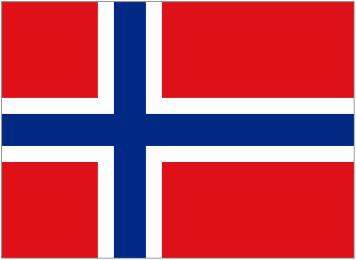
Can Norway carry their attacking edge into this World Cup showdown, or will Côte d'Ivoire make the decisive statement?
Côte d'Ivoire and Norway meet in a World Cup 2026 clash that carries plenty of intrigue. Both sides arrive with contrasting recent narratives, and the margin for error should be slim in a contest where one moment could settle everything.
Côte d'Ivoire come into this fixture with a compact recent record, taking two wins from their last three and limiting the damage in the games that have mattered most. Their overall return of 1.33 goals scored suggests they are not a side that overwhelms opponents for long spells, but they have been efficient enough to stay competitive.
At home, the Ivorians have looked even more controlled, winning their only match at this venue while keeping the scoreline manageable. With no congestion concerns, they should be able to lean on a settled approach and make this a physically demanding contest, especially if they can slow Norway's rhythm early.
There is no meaningful recent head-to-head history to lean on here, so the matchup is being shaped more by current form and selection choices than by any established rivalry. That leaves the tactical contrast, Côte d'Ivoire's discipline against Norway's attacking punch, as the key storyline.
With no H2H trend to guide expectations, the venue may carry extra weight. Côte d'Ivoire's home setup looks designed to keep the game tight, while Norway's scoring profile suggests they can hurt opponents if their strongest forwards are involved.
The market leans toward a competitive game rather than a one-sided result, and the numbers support that view. Norway carry the more explosive attack, but recent rotation around Haaland and other starters makes their true level harder to pin down, especially after a heavy defeat to France when the lineup was changed extensively.
Côte d'Ivoire's home edge and more measured profile point to a contest where both teams should have moments, but neither is likely to dominate for long. The clearest angle is goals at both ends and a narrow edge either way, with 1-1 the most natural call if Norway do not field a fully settled front line.
Norway arrive with stronger attacking numbers, scoring 2.67 goals per match overall and a striking 4-goal average in their lone away outing. Even so, the bigger story is rotation, as recent reports show Ståle Solbakken resting Erling Haaland and other key starters, a clear sign that freshness and squad management are shaping selection.
That approach has real implications here. Norway's loss to France exposed how vulnerable they can become when major pieces are missing or undercooked, and while Haaland is not being treated as injured, the short-term uncertainty around his usage makes their attacking ceiling harder to judge. If Norway go strong, their firepower is obvious, but if the rotation continues, the visitors lose some of the force that makes them such a dangerous opponent.